MASTERCLASS
Building Personal Brand Lead Gen Machines
Listen On

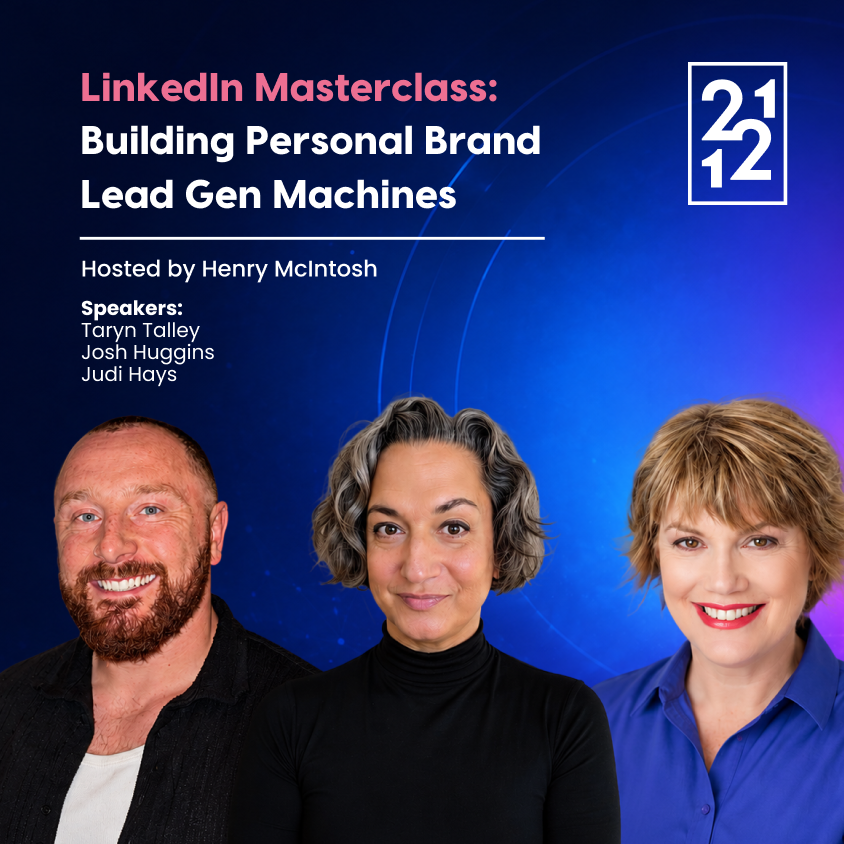
2112 Growth Forum LinkedIn Masterclass hosted by Henry McIntosh
Henry McIntosh of 2112 Marketing hosts a LinkedIn masterclass with three subject matter experts: Taryn Talley, Josh Huggins, and Judi Hays. Together they cover whether LinkedIn still drives commercial growth, where to start if your presence is thin, and how to turn real experience into content that resonates instead of noise.
The panel also digs into a newer topic: how LinkedIn shows up inside AI answer engines like ChatGPT and Gemini, why FAQs and a clear niche help you get cited, and why personal brand is outperforming company pages in B2B right now.
Episode Key Takeaways
- LinkedIn is still commercially viable: With roughly 1.2 billion members, it remains a core channel for B2B relationship building, even as AI reshapes what gets seen.
- Start with clarity, not content: Know exactly who you are trying to reach and what outcome you provide before you post.
- Share your lived experience, not a resume: A unique point of view builds credibility faster than a list of accomplishments.
- Comments and DMs are underused: They are not touched by algorithm suppression the way posts can be, and personalized, human outreach still works.
- Build your digital neighborhood for AI search: A website with structured data, a strong LinkedIn presence, podcasts, and press all feed what LLMs say about you.
- Personal brand is outperforming company pages: LinkedIn favors reach for individuals with a real story, though company pages still matter for employee advocacy.
Resources
Watch Now
Appearances By

Taryn Talley
Taryn Talley works at the intersection of go-to-market and brand marketing for Series A and B companies, and has been featured in Nasdaq, Authority Magazine, and Thrive Global. Learn more about Taryn Talley.

Henry McIntosh
Henry McIntosh is the founder of 2112 Marketing (Twenty One Twelve) and hosts the 2112 Growth Forum, where he explores the ideas, channels, and strategies that help businesses drive growth. He is also building Noteworthy, an AI video interview tool. Learn more about Henry McIntosh.
Josh Huggins
Josh Huggins is the founder of Blueberry Media, an agency that helps B2B founders and leaders tell human stories and build personal brands on LinkedIn. Learn more about Josh Huggins.

Judi Hays
Judi Hays is a personal brand strategist, executive positioning advisor, and LinkedIn expert. She positions experienced professionals and leaders of established, expert-led B2B consulting and professional-services firms for visibility, authority, and decision-maker conversations. Learn more about Judi Hays.
Show Transcript
This transcript was generated from the episode audio and lightly edited to remove filler words and obvious repetitions. It may contain transcription errors.
Henry McIntosh:
Hello everyone, and thank you all for coming today to the 2112 Growth Forum, where we explore the ideas, channels, and strategies that help businesses drive better growth. Today we're focusing on LinkedIn. It's a platform that most people in B2B know they should probably be using, but there's still a lot of uncertainty around how to use it well. To demystify it for you, we've got three brilliant subject matter experts: Taryn, Josh, and Judi. Welcome, guys. The aim of today is to make this as practical as possible. We're here to understand what actually works, how LinkedIn can be used to build trust, create demand, and generate pipeline for your businesses. Before we get to intros, we're going to start with a quick poll to get a grasp on where you all are with your LinkedIn strategies right now. If I could hand over to you for a quick intro. Taryn, can we start with you?
Taryn:
Sure. I've been in marketing for over 20 years, scaling marketing programs and campaigns at companies like AstraZeneca, JPMorgan Chase, and Roku. Currently I'm working at the intersection of go-to-market and brand marketing, helping companies in the Series A or Series B stage, and I really enjoy producing content and helping people deliver content, especially on LinkedIn.
Henry McIntosh:
Amazing. Judi?
Judi Hays:
Hi, I'm Judi Hays. I'm a New York City-based LinkedIn strategist, and I work with senior executives and founder-led firms who have strong reputations but aren't visible to the buyers who need to see them. They haven't claimed their niche or positioned their expertise, specifically on LinkedIn. That's the gap I close. I help them become visible experts.
Henry McIntosh:
Amazing. And by way of intro for Josh, he's a leadership expert. He's worked in big business and helped startups, but he can do a better job of explaining who he is than I can. Josh, would you like to do a quick intro?
Josh:
I'd love to. My name is Josh. I have a background in psychology, actually. I spent 10 years in the world of engagement, culture, and leadership, working with enterprise businesses on how to create trust with employees, with community, and in the market. Now I run an agency that does something very similar for business owners.
Henry McIntosh:
Amazing, thanks so much. Our poll answers are in, and the majority say LinkedIn is a core growth channel for their business, but a decent percentage also say they're not using it effectively enough. So this is a good place to be, wherever you are in your journey. The first question, and it's probably the biggest one, because we can just shut our laptops if the answer is no: is LinkedIn still commercially viable? Does it drive commercial growth, or is it just vanity metrics? Who wants to take that one?
Taryn:
I'll put my hand up. It's still commercially viable. There's a whole bunch of alternatives coming, but LinkedIn is still the singular place where most people are active at various levels. There are more specialty platforms, but I think LinkedIn is still very relevant, and it's been making changes to stay relevant.
Judi Hays:
I'd add that LinkedIn has grown up. It started as a resume and job-search board, then moved into the lead-generation phase, then became a creator platform, and now I think it's had a bit of a reckoning, and it's concerning how AI is filtering certain things on LinkedIn. But I still think it's a viable platform, mainly because of the scale, something like 1.2 billion members. That's a lot of people, so LinkedIn can be part of the toolbox you use for business development and relationship building.
Henry McIntosh:
For sure. Josh, is that what you're seeing across your client base?
Josh:
I'd agree. In terms of commercial ROI, I think you can split it into two buckets. Are you booking real, valuable commercial conversations through the platform in some way, and there are methodologies you can use to track that back to LinkedIn. I'd also look at whether your sales conversations are warmer when you're active on LinkedIn, whether people already have prior context on the business or your story. That's a good indication that it's a commercial platform you can use effectively to grow pipeline.
Henry McIntosh:
For sure. So the key takeaway is that your ideal clients are probably on LinkedIn in some shape or form. Let's start from the beginning. Where should people start, if we go back to basics? If someone came to you today and said, I'm not doing much on LinkedIn, what would you recommend?
Josh:
I think the starting point I'd always go with is your experience, your story, your real background and credibility, because that's a unique differentiator everyone on this call will have. You could be on a call with a bunch of different consultants or service providers, but not everyone has the same story and credibility you bring. If you can find a way to leverage your real experience and turn it into assets and content people can relate to, that's always a good starting point, because it's true to you.
Judi Hays:
I'd add that it's about defining and understanding your value proposition. As you're developing content and your profile, nobody wants a resume. They want your perspective, your hot take, your point of view on things. The value lies in our lived experience. It's not "I did this campaign," it has to be a unique, thought-leadership take, and that's not saying what something is, it's saying what your experience with it was and what you learned from it. A lot of people just push content out like a newswire, with zero engagement, when sharing that perspective is the sweet spot.
Then, going back to marketing 101: who is your audience? Who are you trying to reach? Have clarity on that. When I'm working with people, sometimes it's "I want to reach this and this and this," and now you really need to be laser-focused. And it's always the profile, too. You can't post your way to authority. The profile has to demonstrate that you can be found, known, liked, and trusted, and you have to build that credibility. When you have clarity on who you want to reach, and you have an outcome you provide to that audience, and there's relevance, that's when it all comes together. Without starting from those fundamental questions, you're kind of throwing things at the wall to see what sticks.
Henry McIntosh:
For sure, and it's always interesting how few people put in the work on the foundations: who are you trying to target, what are they interested in. In terms of those personal stories, that differentiator, how do you get that out of a client when you're working with them? How would you recommend someone go through that process themselves? Are there any frameworks or tools?
Judi Hays:
Here's a funny thing: if you've gone to an event and you meet somebody, and they start talking about themselves, "I do this and I do that," your eyes are rolling and you want to get out of the conversation. It's not interesting. But if you start talking in a way that relates to the person you're talking to, and you've got their ear, it's a fine line between saying you're an expert without saying "I'm great." It's saying it in a way that speaks directly to the ideal audience you want to reach. It's flipping the script.
Henry McIntosh:
I love that analogy, because if you were in person, you wouldn't just launch into a thousand-page pitch straight away. Taryn, anything to add on your process for getting these ideas out of people?
Taryn:
I meet with people, whether I'm helping optimize their profile, their posting cadence, their messaging, or comms. I talk to them, find out what they're trying to accomplish, going back to Judi's point on marketing 101: who are you targeting, what are your goals? A lot of people are hesitant because it feels like a part-time job on top of everything else, so it's about keeping it simple, understanding who they're targeting, what the objectives are, what their value prop is, and building a customized plan from that.
For me, I write in the voice of maybe five people on LinkedIn, and I turn that into a conversation about what's important to them, what their values are, because, going back to what Henry said last night, people buy from people. You have to show a little bit about who you are, how you think, what you're interested in, how you work, and what your values and ethics are. That's what I have to unpack in an intro call, to find out whether I can help someone.
Josh:
I'll go super practical, for the person thinking about how to turn this into something valuable. Most of us are talking to clients, customers, and partners all the time, on Zoom, Google Meet, Teams. Look at your conversations, look at your client calls, look at what they're asking, and think about whether there are themes you can turn into something valuable, because we don't jump on client calls and pitch ideas, we have conversations as human beings. If you can transcribe those conversations, or at least theme them, you can create content that's real, based on real client calls, and distribute it knowing it's already coming from your potential customer.
Judi Hays:
One thing that's really important is to set expectations. What is LinkedIn supposed to do? It should not be where you are selling. It should be where you are developing the relationship, building on what Taryn said, that people do business with people. If you're using LinkedIn to prime that relationship, the objective is to get the conversation offline, onto a Zoom call or a meeting, beyond LinkedIn, because LinkedIn is one part of that process. A lot of people work too hard on LinkedIn trying to sell, and it's off-putting. It's more about relationship building at the core.
Henry McIntosh:
For sure. Taryn, you put up an interesting post recently about how events give you an excuse to communicate with your audience. LinkedIn can be a platform to move people into your newsletter, a warmer touchpoint, or into an event, an even warmer touchpoint, which brings in joining the dots between your strategy, because things don't work in a silo. If I'm a founder listening to you talk, this all sounds great, but my biggest problem is I don't have time to do this. Aside from hiring you, what can people do to be consistent with this on LinkedIn, since there's no point going hard for a month and then letting it go fallow? What frameworks or strategies could they use to manage their time?
Taryn:
I'm pretty simple with this. If I have something to say, I'll say it. I post about the intersections for me, share lived experience, share silly things that happened to me over the weekend, mention live events I'm running. I've heard that with the new changes on LinkedIn, they recommend posting a couple of times a week. I have one client that's more ad hoc, could be two posts a week, could be zero some weeks, and another that's consistent at one or two posts a week. You have to find your right cadence: do you have something to add to the conversation, something valuable to say? When people get into their heads about having to post every day, that's a trap. Go for value and quality. Maybe spend a day working on comments for people, because comments are a great way to raise visibility. Sometimes a comment gets 20,000 impressions when your own post doesn't. And engage with people's posts, this is a social network, not a place to holler into a void. Jump on other people's posts, share insights. You never know what will come out of that connection.
Henry McIntosh:
For sure. Judi, we've had clients pour everything into one big campaign post, and by the time it's gone out to everyone, the message gets lost and it's honestly a bit boring. Anything to add?
Judi Hays:
On the commenting point, I'll bring back the in-person-event analogy: you go from conversation to conversation, and that's the commenting part. I've seen the reach on commenting go much further than on posts, and if you're posting just to check a box, you're creating noise. If you want something that actually works for you, look at posting an article or a newsletter, because that's indexed by Google and has a life beyond the feed. I've had clients tell me they found me through ChatGPT, which tells you it's indexing that content.
The other thing is identifying who already has the audience you want to reach and getting into that conversation, and the other underused tool is direct messaging, which the algorithm doesn't touch. Look at your network, the people you've lost touch with, and reach out to reconnect. It's not about vanity metrics. Inflated metrics don't lead to business.
Henry McIntosh:
That's a really interesting point about virality. Josh, you've spoken about this before, since you've gone viral yourself. People come to you wanting to go viral. Can you share your view?
Josh:
It's a valid point Judi touched on. Virality isn't a system, it isn't something consistent. It's something that explodes, which might be great for your ego and your metrics, some spikes, but it's difficult to engineer consistently. I'd rather my clients have a structure and a system that's consistent and manageable. Virality may help, but it can also hurt your profile, because you can go viral for the wrong things: is it your dog, or your new client? You can go viral for things that don't support your profile or your network. If virality is the game you're playing, I don't know that the platform will support your business in the long run.
To Judi's point on direct messaging, for me it's about just being human, curious, interested. The number of conversations that generates for us as an agency, and for clients, from being curious about what other people are doing, finding overlap in our work or background, and asking the right questions, because people are generally very conversational. It's a social network. Lean into that.
Henry McIntosh:
What comes through is consistency, whatever you do. And I love that idea of curiosity, Josh, that opens doors. Since the LinkedIn DM is much maligned, we've all had the connection request followed by an essay all about their service. Are you suggesting people should weave DMs into their strategy? How personalized does it need to be?
Josh:
Ultra-personalized. It can't scale meaningful relationships, and people can see right through it, especially with things being scraped. I've gotten messages that clearly never looked at my profile.
Henry McIntosh:
I got one recently asking if I wanted to reserve some sunbeds. They clearly had no idea where that was coming from, and it does nothing but reduce credibility.
Judi Hays:
Personalized, real, human, let's be good people. About 72 to 73 percent of the people I work with or train have never downloaded their LinkedIn network database, and LinkedIn has made it harder to do. I encourage people to download their network database, look at it, and see who they've lost touch with, because there's about 20 percent job turnover every year. To have a connection and not engage with it, but do it genuinely, without an agenda, as a way to engage human to human, matters.
Taryn:
On the DM strategy, I use that to build community for my events. I search LinkedIn, since I don't use Sales Navigator, for people who fit the criteria I'm looking for, then look at second-degree connections, their profile, their featured posts, the last few things they've done, to get a vibe for what they're doing. Then I write a message that takes time: "I love what you said about generative AI and the lack of governance, we have a great event coming up, I'd love to invite you," and drop the link, made very personable. The worst thing is AI-generated outreach, it's so easy to spot when it's been scraped, when it sounds like filler with zero value. You have to make it personal and connect to it. That's part of the work, and a lot of people don't want to do it, they want to scale and automate, and that just doesn't cut it.
Henry McIntosh:
Taryn, you hit the nail on the head, it's about providing value, and a personalized invitation to an event is a lot of value. On the job-change comment around audience: people on this call may have changed jobs or sectors over the years, so their LinkedIn audience has probably changed too. Does your audience composition matter in terms of how far your content goes?
Judi Hays:
When you look at first, second, and third degree, people have asked whether they should remove people. In my case, I lived in Austin, Texas for a long time and connected with the Chamber of Commerce there, then moved to New York. Do I disconnect from all the Austin people? No. As it happens, some of them have since relocated to New York. Your network affects how you can grow based on those degrees of connection. The other thing is to go through and, for the people you want to see in your feed and notifications, use the notification bell and unfollow people you don't want to see, without disconnecting. Use the three dots to do that. That way you get a nice curated set of content to engage with, and you can stay in your notification lane instead of the open feed.
Henry McIntosh:
For sure, I'm seeing a lot more posts from people I don't know in my feed lately. But Judi, last time you described the newsfeed as a crime scene, which I love.
Judi Hays:
And my inbox is a crime scene too.
Henry McIntosh:
I want to bring this back to LLMs, because it's really interesting when we talk about LinkedIn working commercially. Everyone's obsessed with AEO and SEO, our next forum is actually on that topic. Some research has come out that Reddit was the most cited platform for LLMs, and now it's supposedly LinkedIn, and you mentioned it's indexed by Google too. Are you taking advantage of that for clients, or is it a nice byproduct?
Taryn:
I stumbled into GEO last year. One of the things I do when I'm starting with a potential client is look at where they show up in Gemini, because GEO and AEO have been an added bonus for me, beyond LinkedIn. Reddit is still number one from what I heard, but LinkedIn is number two or three, a huge contributor. For me it's not just LinkedIn, it's everywhere: a Linktree, a website, media publications, all of that gets picked up when you look someone up in Gemini. It builds almost a two-page synopsis of everything about you.
I tested this recently, logged out, asking ChatGPT how I'm doing for speaking engagements. It gave me an analysis of where I show up and recommendations on where I should go speak. That's the result of GEO. Once it knows about you, it can help you double down on the right lanes. That excites me. I fell into it last year and have been embracing it.
Henry McIntosh:
We've started tracking some of the acquisitions coming through AI now, seeing hits from Perplexity, ChatGPT, and similar tools. We don't overly index on that as a channel, but because we distribute ourselves across multiple platforms with our content, it's picking us up and filtering through, and I think that's where we need to keep heading.
Judi Hays:
LinkedIn has always held a very high Moz score, I think in the high 90s, which stands for credibility, and I think that's part of why LLMs are pulling in LinkedIn content, because your actual profile is connected to what you're saying, unlike other platforms where you can have avatars. Another underused aspect of LinkedIn is that if you're a solopreneur or have a small company, you should have a company page, and so many people don't. That's a missed opportunity. Taryn, when you're doing that sort of poll on where you're showing up, the more pieces you have in that puzzle for visibility, the more you show up.
The third thing I'll add is that with my clients, we've changed our blog strategy to add FAQs, because even a Google search now often just returns the AI aggregation. If you optimize your H1 tags, your key takeaways, and your FAQs on a blog post, you signal to the LLM that this content is relevant to what's being searched. Employ that strategy across LinkedIn and the other platforms, and I think you'll show up more.
Henry McIntosh:
So FAQs are a really good way to get into answer-engine optimization.
Judi Hays:
Yes, have that question and the answer show up as the answer.
Henry McIntosh:
I love that approach. They also weirdly love comparison tables, so you're seeing people list their competitors on their own websites, and we've got a few builds right now where we're suggesting adding a comparison table. It needs to be neutral and honest, but the LLMs only read compartmentalized pieces of a page, whereas Google reads the whole thing. As we move toward zero-click marketing, where people don't visit your website at all, looking at platforms like LinkedIn and how you take advantage of them is becoming more crucial.
I want to push you all on something. Say someone came to you and said, I want you to help me with my GEO, drive my personal brand, and turn it into a pipeline-generating machine. What exact framework are you suggesting in terms of newsletters, articles, posts, and DMs? What does that look like?
Taryn:
For me, when I'm meeting with people, I'm part of a couple of communities, one with 15,000 people I help support and add value to. I talk to folks about a "PR hype machine." I help people look for PR opportunities that showcase their lived experience. I use sites like Qwoted to find media opportunities for myself and others, and there are similar things in different regions. I did a strategy for an Australian doctor who wanted to get into speaking, and found there were local equivalents she could use to get media appearances.
Think of GEO this way: your home base, your home entity, is your website. You need structured, machine-readable code, a schema, so machines can index it. But you also need a digital neighborhood. You can have a great website and a great LinkedIn presence, but if you're nowhere else, that digital neighborhood is very small. The whole purpose is to build the biggest neighborhood you can within your brand, your ICP, your messaging, and your experience, and own that space. I feel like I'm everywhere, and that everywhere moment generates results, for me and for the LLMs.
Judi Hays:
I'd add that when you do that and own that space, you become a category of one, which is where that visible expertise comes in. It goes back to having clarity in who you're trying to reach, very specific, not a group. If I say "I'm talking to you," you identify with that if you're the ICP. The other thing I'd say is guesting on podcasts, guesting on webinars like this one, and publishing a book. I work with a lot of clients who have their own IP, their own framework, and publishing a book is one of the most underleveraged tools out there, and it's not hard to do. I've done it both ways, with a publisher and self-published. The goal of my book is to give it away. I don't care if it sells. It opens doors, sets me apart from competition, and is something I can gift to clients and prospects.
If you're not ready to launch your own podcast, look at where those people already have an audience and guest on their show, because you're leveraging their audience and adding value. When you fill in those boxes, when somebody searches for the expertise you offer, you show up.
Henry McIntosh:
I can put myself in the mind of someone on this call thinking, I have to be everywhere and do all of this at once. I think you can be strategic and smart about repurposing and redistributing things, rather than creating everything brand new. If you have a couple of key conversations, document your thoughts, turn that into content, take a high-performing piece and turn it into a newsletter, then turn that newsletter into a blog post. There's a way to streamline what you create, but best case, ripple your brand across different mediums where it's realistic for you.
Josh:
I gave a client the same advice, since they felt they didn't have the bandwidth to create content. You don't have to create something new every time, repurpose what you have. I do the same thing myself, write a piece and find ways to elevate and share it further. Can I mention one thing? With that Qwoted platform, spelled Q-W-O-T-E-D, I landed my first media appearance through it, and my first podcast came from being quoted there. You have to work on your pitch and find the right opportunities, but you don't need an exhaustive search, just find one or two things and put real effort into them.
Judi Hays:
To add to what Josh was saying, take your call transcripts, analyze them, and look at whether the same questions come up. That's why I think video content is a really good pillar, not necessarily a fixed theme, because from video you can also get the audio, the text, and sound bites, the assets that revolve around it. Staying in your lane helps, though you can still talk about other things. I posted something about my daughter turning 30, but I put an angle on it: I said something like, "I got hired with no experience, never done this before, but I got the job," and then described the outcome so far. It's about making it relatable, revealing a little of yourself as a person, but underscoring the outcome, not so much what I can do for you but what it results in. If you can capture that in as many ways as possible, it's a powerful message.
Henry McIntosh:
Are there certain content formats you're seeing work better right now? What should people focus on?
Taryn:
Going back to what we're using LinkedIn for, building network, relationships, and credibility, video is always a great way to do that. People connect with your voice, your face, your background, and it starts a good conversation. It adds a layer of relatability. Ultimately everything can work on LinkedIn, it depends on the outcome you want, but if we can create a foundation where video is accessible for you as a leader, we can repurpose it into transcripts, text posts, infographics, and more.
Judi Hays:
One other thing: repetition, having a theme, is a positive. It's like a billboard, you keep seeing something, and eventually it sets in, and when you need to take action, you remember it. Not necessarily saying it the same way every time, but recasting it. My whole thing has been "download your database, please, it's your network," and I say it fifty different ways, but people still aren't doing it, so I have to keep breaking through that. Another underused tactic is the voice note in the mobile app. I connected with someone, we messaged back and forth, and I sent a voice note, and he asked if it was AI-generated. First of all, you can't do that on LinkedIn yet, as far as I know, but it made me realize how fatigued people are, wondering whether something is really you or a digital copy of you. Using tactics like that, not overusing them, but when they're relevant, helps you break through.
Henry McIntosh:
Is there one top tip right now that's working particularly well, or is it an amalgamation of everything we've discussed?
Taryn:
I wouldn't give a single "go do this" tip. What I'd say is: stop letting LLMs generate all your content. With the changes on LinkedIn, that content will be deprioritized, we've seen the credibility markers appear on AI-generated images. Put effort into writing genuinely good content, stop relying on the crutch of AI. If you're commenting on someone's post, be legitimate, don't just ask ChatGPT for a take and paste it in. People want to see you, your lived experience, don't shortcut it. I use AI every day, but it doesn't generate the bulk of my content. Understand how the platform works: content like that gets deprioritized, and video without a punchy first 15 seconds gets deprioritized too. People are increasingly seeing content based on their preferences, which is the recommendation LLM at work, so you have to play into that.
Judi Hays:
I'd also say take a look at your headline. I mentioned this in our prep call: it shows up in maybe 10 or 12 places, and people make snap judgments seeing your headline and profile photo. Does it spark curiosity, make someone want to see what you do and look at your profile? Your About section should be written not about you, it's about what you represent to your ideal audience, speaking to them directly. Go into your profile and fill in everything.
On LLMs, I've been going through the Claude Anthropic Academy, which I'd recommend to everybody, and I've added that to my LinkedIn profile, because I'm getting well-versed in it, not just using it as a crutch, but as a way to ideate and analyze, and to become a better steward of these tools.
Henry McIntosh:
Josh, final thoughts?
Josh:
I'll close with this: just invest the time to be active and be social. This isn't going to change overnight, it's something you have to invest in, and it does take work, as everyone's said. Invest the time within what's capable in your diary, but it does work, and it opens some really exciting doors. We're all here today because we're connected across different parts of the world, and it's worth doing if you can invest the time.
Henry McIntosh:
Amazing, a very global call. I want to open it up to questions for our final ten minutes. First from Donovan: if someone's posting consistently but getting no business results, what's usually going wrong?
Judi Hays:
Two things. Either you're not connected with the right market, or you are, but you're not resonating, not tapping into that pain, so you're irrelevant, and that's the invisible part.
Henry McIntosh:
Linda also asked: is LinkedIn suppression real, and if so, what can you do about it? I'm guessing this is the shadow-banning term.
Taryn:
Yeah, I mean, I'd say yes. For the past couple of years I've had to deal with some suppression, I don't know if it came from virality or what, but since they made changes and dropped the algorithm for the LLMs, I've seen less suppression, honestly. Take a look at your metrics: impressions are like open rates on email, pure vanity, means little on their own. Look at members reached. Back when I felt suppressed, I might have had 20,000 impressions in a week but only reached 3,000 members, which is a bad ratio. Check whether the hashtags you're using are actually showing up in search. Follow the platform's loose rules and see what you can do about content that resonates.
Judi Hays:
I did a test, posting the same outside article three different ways to see which performed best: a direct link post (which shows up as a small card), an image with more text, and an image with text overlay plus a key takeaway. The one with text over the image got the highest engagement, which tells me there's a stylistic preference, and I want to try that test again to see if it holds. The other thing I'd say about Linda's question is that the two things not impacted by any shadow-banning or algorithm changes are commenting and direct messaging. Those you control to some degree.
Josh:
I'd add, in response to that question, being conscious of who you let into your network, because I'm sure our connection invitations are a crime scene too. Curate a network that's relevant to whoever you're going after, because it's not that we're gated or exclusive, but each acceptance is a nudge to the algorithm about what you're interested in, and it can give the wrong signal to the platform.
Henry McIntosh:
We've got another question, and this has all been angled around personal brand, but does personal brand now matter more than company brand in B2B?
Josh:
I don't know that it should be prioritized over company brand, but what we're noticing is that you get broader reach as a personal brand with a story and lived experience behind it. LinkedIn favors that reach over a post from a company page. With such low trust in the market, and AI having lowered the barriers to content, people are searching for something human and relatable that they can buy into, so a personal experience or a leader unveiling what's going on in the business tends to take the pedestal over a company brand post. That's not to say company pages aren't valuable, they have a place, but it's about where you put your time.
Taryn:
There's also a piece with the company brand page, where you want to encourage employees, so the company has a positive environment and gets social advocacy from its people, tying into their personal brands, sharing messages from the company brand as loyalists or advocates. I don't think people do that enough. I've driven that for companies, getting the social advocacy score up over nine percent of employees actively commenting, posting, and resharing, and landed a company in a top 100 list for marketing firms when we hit that level.
Judi Hays:
One thing to add: I have a financial advisor, absolutely fantastic, who changed companies. I liked the brand he was with before, but when he moved, I went with the person, not the brand, because of the relationship we had. It wasn't that he worked for a particular firm, it was the human connection. Company brands are important, but it comes down to the person and how you relate to them.
Henry McIntosh:
On the employee advocacy piece, was there a way you achieved that? Did every post go into a Slack channel, and people were trained to like and comment?
Taryn:
It's my natural state to do that. I'll post in Slack, "hey guys, we just had a podcast episode drop, here's what you can comment on, this person is a current client, this person is a prospect, let's show some love," and I make my ask very direct: I need some likes and comments. We're averaging around seven percent now, it's dipped at points, but it's about consistently driving people to support a message, promote a client, or reach and inspire a prospect or lead.
Henry McIntosh:
Amazing. I think that's all the questions. That leaves me to say thank you so much for attending, and thank you to the three of you, that was awesome, I learned a lot. We're going to put the recording up on YouTube, so stay tuned if you want to revisit anything, and I'm sure the guys would be open to helping you with your personal brand professionally. These are the three people I'd speak to, so don't be shy, use LinkedIn DMs and reach out to them.
FAQs
Yes. Judi Hays and the panel agree that with roughly 1.2 billion members, LinkedIn remains a core part of the B2B toolbox for business development and relationship building, even though the platform has changed over the years, from a job board to a lead-generation platform to a creator platform.
The key is watching whether your sales conversations start warmer when prospects already have context on your business from LinkedIn, which is a sign it is working.
Start with your real experience, story, and credibility, since that is a differentiator nobody else can claim. Then get clear on marketing fundamentals: who is your audience, and what outcome do you provide them? Judi Hays says you cannot post your way to authority; the profile has to demonstrate that you can be found, known, liked, and trusted.
Today, Judi helps clients build this foundation in her Strategy Lab.
Look at your real conversations. Josh Huggins suggests reviewing client calls and conversations for recurring themes, since those are proof the content is relevant to real buyers. Judi Hays adds that the value is in your lived experience and point of view, not in stating facts, and that content should work like a breadcrumb toward your expertise, never leading with the sale.
There is no single right cadence. Taryn Talley says some clients post once a week, others two or three times, and the goal is to post only when you have something valuable to add, not to hit a quota. Judi Hays notes that commenting on other people's posts often reaches further than your own posts, and that engaging is part of showing up as a participant on a social network.
The panel says it can happen, but the fix is to look past vanity metrics like impressions and check what percentage of your audience you are actually reaching. Josh Huggins recommends checking whether your hashtags are showing up in search and following the platform's general best practices. Judi Hays adds that commenting and direct messaging are not affected by algorithm suppression the way posts can be, so they are reliable ways to stay visible.
LinkedIn is increasingly cited by large language models, alongside Reddit, partly because of its high credibility ranking and because profiles are tied to real identities. Taryn Talley recommends building a “digital neighborhood”: a website with structured, machine-readable data, plus an active LinkedIn presence, podcasts, and media mentions, so AI tools build an accurate, favorable picture of your expertise.
Judi Hays adds that adding clear FAQs and key takeaways to blog content signals relevance to these systems, the same way it does for search engines.
The panel says personal brand tends to get broader reach on LinkedIn than a company page, especially now that AI has lowered the barrier to generic content and buyers are looking for something human and relatable. Judi Hays shares that she followed her financial advisor to a new firm because of the relationship, not the brand he worked for.
Company pages still matter, particularly for employee advocacy, encouraging a team to share and comment on company content in their own voice.
Make it ultra-personalized. Taryn Talley looks at a person's profile, recent posts, and featured content before writing an invitation that references something specific and genuine. Judi Hays and Josh Huggins agree that scraped or AI-generated outreach is easy to spot and damages credibility, while a human, specific message, without an agenda, still opens doors.
Today, Judi helps clients plan outreach like this in her 90-Day Authority Intensive.