PODCAST INTERVIEW
Do's and Don'ts on LinkedIn: A Live Profile Audit
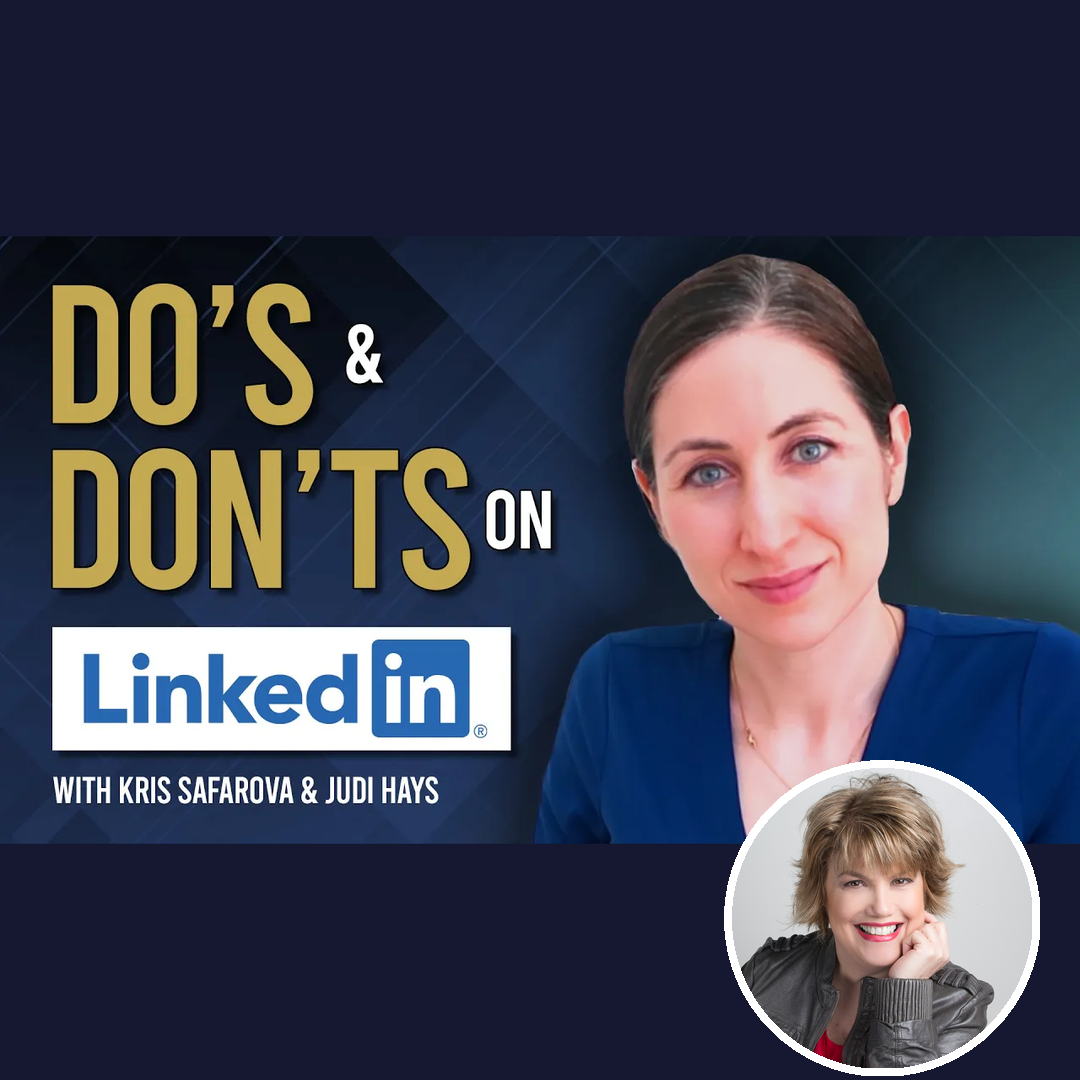
FIRMSconsulting Podcast with Kris Safarova
Kris Safarova invites Judi Hays back to FIRMSconsulting for a second conversation, this time built around a live, on-air audit of Kris’s own LinkedIn profile. Judi first covers the most common mistakes she sees across thousands of profiles: writing a resume instead of a resource, no strategy, the pitch slap, collecting connections without engaging them, and skipping the company page.
Then she walks through Kris’s profile piece by piece: the headline, the About section, the Featured section, recommendations, the company page, and how to structure content across a profile, a company page, and multiple podcast pages so everything drives back to one place.
Episode Key Takeaways
- Your resume looks back; your LinkedIn profile should look forward: it is aspirational, showing how you want to be perceived, not a record of where you have been.
- Never lead with the solution: get clear on the real pain point your buyer feels before you ever mention what you offer.
- Download your connections regularly: sort by company and title, and re-engage the people already in your network instead of collecting new ones.
- Keep your personal profile as the hub: post there first, then share out to a company page or podcast page, so all the engagement equity comes back to you.
- Ask for recommendations in the moment: when someone compliments your work, ask right then if you can turn it into a LinkedIn recommendation.
- Fear is what stops most people: there is an edit button and a delete button, so it is a forgiving platform if you are willing to start.
Resources
- Elevate, Expand, Engage by Judi Hays
- Download a free chapter of Elevate, Expand, Engage
- FIRMSconsulting, Kris Safarova’s strategy training company
- Judi’s first FIRMSconsulting interview with Kris Safarova
Watch Now
Appearances By
Kris Safarova
Kris Safarova is a Wall Street Journal and USA Today bestselling author and the founder and CEO of FIRMSconsulting.com and StrategyTraining.com, where she produces strategy and leadership training videos, podcasts, and books. Learn more about Kris Safarova.

Judi Hays
Judi Hays is a personal brand strategist, executive positioning advisor, and LinkedIn expert. She positions experienced professionals and leaders of established, expert-led B2B consulting and professional-services firms for visibility, authority, and decision-maker conversations. Learn more about Judi Hays.
Show Transcript
This transcript was generated from the episode audio and lightly edited to remove filler words and obvious repetitions. It may contain transcription errors.
Kris Safarova:
Today we have Judi Hays. Judi is the author of Elevate, Expand, Engage. She's a LinkedIn expert and content marketing strategist. Welcome, Judi, it's great to have you on the show.
Judi Hays:
Thank you, Kris. I'm honored to be here. Thank you for inviting me.
Kris Safarova:
Before we jump into the presentation you so kindly prepared for us, could you take us back and share your backstory? I know you've spent time in Texas, San Francisco, and New York, and you're a woman of many skills. Take us back to how you ended up working in advertising in New York City, and what led you to focus on helping people build their professional brand using LinkedIn.
Judi Hays:
I don't want to tell you how many years, because then you'll know how old I am. When I started my original career, I was working in the advertising industry in New York City for a direct marketing firm, and back then that was the stuff you got in the mail, known as junk mail. What was interesting is that they used a lot of techniques: testing, targeted lists, very focused. I got more involved in that, then branched into other areas, but one thing that struck me was the idea of one-to-one marketing. With mass marketing, people get it through repetition, and eventually think, that's what I want, because I keep seeing it. With one-to-one marketing, it's a personal engagement between two people.
That's what drew me to LinkedIn. When it first launched, it was more of a job site. You had to know people to connect with them, and it was a way to show what you're all about. Then it moved into lead generation, it got more crowded, and there was a need to stand out. Now LinkedIn is really focusing on content, and I love it, because content is a great way to educate and delight your audience, and you can still do it in a one-to-one way. Whatever I do, I'm talking to you, Kris, not to everybody who's kind of like Kris, because otherwise it's not relevant to them. So that's where we are today: using LinkedIn to present your personal brand in a way that's relevant to the audience you're speaking to. That's my story.
Kris Safarova:
How did you end up at that advertising firm?
Judi Hays:
I'm going to date myself again. There used to be something called the agency black book. I had an uncle in the ad business, and I asked him to introduce me. He said, if you want a job in advertising, write to all these agencies. So I sent out about 150 letters, back when you did that by mail, and I got 11 rejections and one phone call. That phone call became the job I took, and I worked there for seven years in New York City. Then I moved to San Francisco, and after 12 years there, I moved to Austin, Texas, and most recently back to Brooklyn, New York.
I was focused on an end result: I wanted a job at an advertising agency. I put together my package, my letter and my resume, targeted who I wanted to reach, and tracked the response. It was a low response rate, but all I needed was one yes. That's all I needed. It comes back to what we do today: targeted marketing, a clear objective, and using the tools available.
Kris Safarova:
I know you had a defining moment at that agency, when your boss told you never to come to him without something.
Judi Hays:
You remember that, you do your homework. I was the assistant, just a kid working in New York City, for the executive art director of the agency, a really busy guy. I remember once I didn't feel empowered to make a decision, so I came to him with the problem, and he basically scolded me. He said, don't you ever come in here with a problem unless you've taken the time to think about ways to solve it and present me with options. I was just a little kid, and I thought I was going to cry, but it stuck with me, and it became an underlying foundation of how I work. I want to work with people who take initiative and think it through. It's easy to go to somebody and say, it doesn't work, what do you want me to do? Instead: here's why I think it doesn't work, and here are some things we could try, which one do you like? That's a whole different mindset. It was brutal in the moment, but he was right.
Kris Safarova:
What's the origin story of your current business?
Judi Hays:
This business has evolved in many ways. I'd been an employee for a while, then went out on my own, then wanted to return to New York City, and found a job that moved me back. After six months, it wasn't a fit, and I got fired. I actually saw it as a good thing. I thought, I can really do anything I want, so I started talking to people and playing around with different things.
One thing I liked was looking at what makes content work on social media, so I started providing social media metrics analysis for a PR firm, looking at audience and engagement. Out of all the platforms, I really enjoyed LinkedIn, probably because it's at the business-to-business level. It felt like the grown-ups were on LinkedIn, and I liked figuring out what made it work. A coach I worked with told me: if you're a marketer, there's one in a million, a digital marketer, one in a couple thousand, a social media expert, one in a couple hundred, but a LinkedIn strategist, you're one of a kind. My fear was that if I said I just did LinkedIn, I'd lose all the other opportunities, but that was the furthest from the truth, because LinkedIn is the gateway drug. Most of my clients, I'm also managing their websites, their email programs, helping them develop content and get media placements, but LinkedIn is where we put most of the investment and use it as a channel out to everything else. That's been the case since 2015, when I launched the business, and I formed a corporation in 2018.
I'm basically genetically unemployable, I can't work for anybody. I set my own hours, work with a lot of West Coast clients, so I start around 10 and work into the evening. There's nothing like having your own business, though it's not all smooth sailing. With freedom comes responsibility. My clients always come first because they're the lifeblood of the business, but I make it work around whatever else comes up. About 80 percent of my business has been referrals or previous clients, and the other 20 percent has come from people finding me online, through a Google search or a webinar. I haven't done a lot of outbound. Understanding where your business is coming from is a really good exercise, because you want to go back and replicate that, which is why nurturing your existing network matters.
I do have a team. I'm the lead, but I have a strategic partner who's really good with defining the target and the pipeline strategy, while I'm strong on branding and content creation. We collaborate on projects and have people supporting us. I also have two on staff: my dogs. One is in charge of social media, and the other is in charge of security.
Kris Safarova:
I know you prepared a presentation for us. Let's jump into it.
Judi Hays:
What I hear from a lot of people is, why should I be on LinkedIn? When you're on LinkedIn, you're presenting yourself professionally, and you can create thought leadership, meaning you lead with your thoughts about what you do. By the way, a few people over the course of my work told me I should put my ideas in a book, so I took their advice, and this is the book. If you want a free chapter, go to my website and grab it.
So, why LinkedIn? I hate to date myself again, but I don't know if everyone knows what a Rolodex is, this big carousel you'd spin around. LinkedIn is the largest business-to-business Rolodex, all business professionals. If you type your name into Google, your LinkedIn profile is probably going to be the first or second result. That's how important it is. It's a great way to build your brand, and if you don't have a website, LinkedIn becomes your website. It's also a great way to get intelligence on companies, especially with Sales Navigator, the premium subscription. And it gives you the opportunity to publish and become visible, network, and meet people. My own network spans the globe, from New Zealand to the UK to India.
Today I want to talk about common mistakes. In the thousands of profiles I've reviewed and worked on, I keep seeing the same things again and again, and these things are costing people their reputation, because if somebody wants to do business with you, they're going to do their due diligence and search for you.
The first mistake, because of how LinkedIn started, is that people's profiles read like a resume. It's all about the person, like a copy of their CV. Boring. It needs to be a resource. Your resume looks backward, it's your work experience up to now. LinkedIn is where you can determine and set the stage for how you want to be perceived and where you want to go. Think of it as aspirational. If you get one thing out of today, that's it: your resume is your background, LinkedIn is how you want to be perceived.
Here's a lesson I learned early in advertising: if you want to be taken seriously, you've got to dress the part. LinkedIn is a professional virtual event, a virtual networking event, so be professional. Dressing the part means a good profile photo, not one where your arm is around somebody, or with your kid or your dog in it. You want to use LinkedIn to inform and educate your buyers, to help them become a better buyer of your service, and you do that through content that creates curiosity, so when somebody sees your picture and reads your headline, because you commented on something, they think, I want to know what that person does, let me click on that. Being relevant is knowing your audience and creating content and conversations that relate to who you want to engage with.
Here's the crazy thing: your profile is not about you. It felt a little odd, Kris, when you asked me to tell you about myself at the start, because I could talk about myself all day, but I really want to know about you. That's the odd thing about LinkedIn: it's not about you, it's about your audience, your reader.
Let me give you a before-and-after example. One of my clients is a coach who works with technical engineers who've moved into leadership roles. Her original profile said something like "I help entrepreneurs," which wasn't even her real audience, it was technical experts. She also had a podcast she wasn't promoting, and a nice tagline, "catalyst for change." On the before version, it's all "I" and "me." On the after version, it speaks directly to her target audience: I'm talking to you as an engineer and technical expert moving into leadership, and here are three strategies. It's about her expertise, but framed around the reader, not about her.
Here's another example, a healthcare professional client. His original profile was a generic, "stalker" profile, you don't know anything about the guy. We built out his headline so it actually informs people what he does, including that he's a Lean Six Sigma Black Belt, and led with a pain point about the challenges in healthcare organizations. That's the difference between a resume-style profile and a resource-style profile. I have other examples of About sections written for the reader, not the person, that I'd encourage people to look at on the YouTube version of this.
Another mistake is having no strategy. People say LinkedIn doesn't work, but it's because there's no strategy: random engagement, hot and heavy for a few days, then nothing for a month or two. Your network is a mishmash, with no real focus. You're a spectator, not really engaged, just kind of lurking, randomly liking things without commenting, looking in from the outside at this networking event happening around you. Bottom line, if you say LinkedIn doesn't work, it's because you're not working it.
Another mistake is what I call the pitch slap, or the bait and switch: connect and pitch. This comes from people using LinkedIn purely to sell, which puts a lot of people off. If you met somebody at a professional event and they immediately started telling you what they sell, how would you feel? You don't even know them yet. That's a pitch slap. Instead, remember there's a human on the other side. Be human to human, be resourceful, ask what challenges someone is dealing with. When you introduced me and asked me to talk about myself, I could have said I'd rather hear about you, how did you start this podcast, how did you get into this. Turn it around and be a resource. That's how you build credibility, through helping people and building rapport. My strongest advocates are people I've met on LinkedIn and cultivated relationships with. You have to earn the right to sell. You should never be selling on LinkedIn. What you want is to get to the point where they're asking you about your services, because you've earned that right. Remember, nobody wants to be sold to, but everybody loves to buy.
Another mistake is collecting connections, like a drawer full of business cards you never follow up on. If a connection request has no personalized message, that's why you don't remember where it came from. Always personalize your message, so the other person remembers you.
One thing you can do is download your database. There's a "Me" icon at the top of your navigation. Go to Settings and Privacy, then "How LinkedIn uses your data," and select "Download your data." Do this as a regular habit, since it's your network, and you don't want to lose it. It gives you six fields: first name, last name, title, company, email, and connection date. When I'm working with clients, I sort by company, then filter for certain titles, say everyone who's a coach or an author, and look at who I've connected with but never engaged. Then I reach out genuinely, not to sell, just to reconnect: I saw you did such-and-such, I'd love to learn more, can we chat? That's a great way to stop collecting connections and start engaging with your network. There's a lot of low-hanging fruit already in your network.
You should always be growing your network relevantly. The way I grow mine is by looking at speakers at events in industries I work with, and reaching out to say I'm attending this event, I see you're speaking, I'd love to connect and learn more, something personal pulled from their profile. Every connection expands your second-degree proximity. LinkedIn works like six degrees of separation, you need something in common, the same university, a shared connection, or a group, or you're outside their network. Growing your network helps you become visible, and since typically only about 10 percent of your network sees what you post, even with a thousand connections, only about a hundred people see your content in the feed.
If somebody sends a generic invitation with no message, I'll still accept it if I remember them, and then follow up personally: thanks for having me as a host, glad we connected. Always welcome people, like you would if someone came to your office. Don't get obsessed with quantity, focus on quality. If someone I don't know wants to connect, I look at whether they're active, whether they're sharing insights and participating. Re-engage with anybody you've lost track of, and mimic how you'd behave in real life.
Another mistake is post and ghost: someone comments on your post, and you never respond. It's like someone hands you their business card at an event, and you just walk away. If you post something, look at the comments and respond, even just acknowledging a great point. I put up an image of someone with a paper bag over their head, because that's how some people behave, too afraid to engage. Don't be afraid, there's a human on the other side. Encourage conversations: comment on things that interest you, ask a question, add to it, give kudos. That's how you connect with your audience.
LinkedIn is powered by an algorithm, with a relevance factor, an engagement factor, and a network factor. LinkedIn will never tell you the exact formula, and I don't think even they fully know it, but pay attention to what gets engagement. Always give more, don't be a taker. The go-giver mentality comes back to you and builds credibility.
A big one: no company page. You've probably seen those generic gray avatars in someone's experience section, which looks sketchy. Sometimes people don't know they can create one as a solopreneur or freelancer. Having a company page helps you get found in a search, and it's a channel where your company can say things about you that would sound like bragging on your own profile, like "our CEO is awesome at interviewing people." Your company page is another channel to amplify your message. I have an example of someone between jobs, a senior financial executive, where we created a simple monogram from his last name, a tagline about leading finance and operations in global organizations, and used that as his company page, so his profile didn't have the sketchy, out-of-work gray avatar. It's not misrepresenting anything, it's just a way to look like the real deal while he's between roles.
You want to be reachable, especially if you're in business development. Check your contact information: you can put up to three website links there. One could be your website, or your company page if you don't have one. The second could be a piece of content, an ebook, a quiz, your blog. The third could be a link to schedule a call. You can add a phone number if you want people to call, I use a Google Voice number so I can screen calls, and an email, I use my business email. As for birthday visibility, I usually turn it off, except for about four weeks before mine, since people use that as a trigger to reach out and re-engage. Only put a Twitter handle if you're actually active and not posting anything controversial there.
Here's another big mistake: outdated or zero recommendations. Think about how you check reviews before buying something or hiring someone. Some people are in regulated industries and can't have them, which is understandable, but most people just haven't asked. I keep a swipe file: whenever someone compliments me, I ask if I can put that on my LinkedIn profile, and send the recommendation request right there. I once wanted to speak at a conference, and asked someone at the hosting organization, who I'd crossed paths with professionally, if he'd say a few words about my work. He said, why don't you draft something and I'll finish it up. I sent it, and within a day I had the recommendation, and it was accurate, just what I'd written, because he'd observed it himself. Don't be afraid to ask, the worst that happens is they say no. If you have great testimonials on your website, get them onto LinkedIn first, then you can use them everywhere else. Also, don't request them all on the same day, or they'll look suspicious, clustered on one date like a bot generated them. Recommendations are social proof, so ask for them regularly.
Let me share a few hacks, ways to use LinkedIn beyond the obvious. First, build a routine, like building a habit at the gym. In as little as 30 minutes a day, start with notifications, that's the first thing I do every time I log in, and I've tuned my settings so I'm only notified about what matters to me. Second, check your inbox, see what needs a response. Third, process your connection invitations, look at the person's profile and activity, and if it makes sense, connect and send a welcome message. I'd say try to invite at least five relevant, personalized connections a day. Then, since you've downloaded your database, engage with two people from it each day, remembering that there's about 20 percent job turnover on LinkedIn every year. Then check your news feed, but don't get lost in it, that can be a black hole. I use the Save feature to come back to things later. If people ask me a question, I like to record a short video answering it and share that as a post.
Another small, kind gesture is endorsing someone's skill, which triggers a notification, a nice way to stay top of mind. Search for different job titles and companies to see what people are doing, and try to request at least two recommendations a month until you have around eight, keeping them reasonably recent rather than years old. You can build this habit in as little as 60 minutes a day, but start with just one of these, notifications, if that's all you do.
A few bonus tips: polls are really effective for business development if used strategically, I have a whole presentation on that on my company page. Fill out the "Open To" section, whether that's consulting, job, or project opportunities, since it feeds LinkedIn's search. Check your visibility and privacy settings regularly, since LinkedIn changes defaults over time, and this is a social network, so you generally want to be visible when you look at other profiles, unless you're a recruiter with a specific reason not to be.
One fun exercise: go to linkedin.com/sales/ssi, your Social Selling Index. If your score is under 45 out of 100, you're getting significantly less reach. Average is 45 to 60. Above 60 up to 75, your reach expands further, and 75 to 90 even more. I'm around 83 to 85. LinkedIn breaks the score into four areas: establishing your brand, finding the right people, engaging with insights, and building relationships, which covers everything we've talked about.
So, in summary: create a professional brand, dress yourself up for the party. Fine-tune your network, be deliberate about who you connect with, and welcome them. Share insights and value, whether that's articles or curated resources, I have an article coming out in Forbes soon about finding content ideas if you're not a natural writer. For one client, we researched and published a list of 60 podcasts in their industry, and it took off, became a resource people wanted to be added to. And build strong relationships, the way you and I met at an event and connected on LinkedIn, and here we are. It takes work on both sides. Please connect with me on LinkedIn, my name is spelled J-U-D-I-H-A-Y-S, and mention this podcast, because I generally don't accept generic invitations. And if you'd like the book, it's on Amazon: Elevate, Expand, Engage.
Kris Safarova:
Now, for the event of the day, we're going to go live to my own profile.
Judi Hays:
One thing you can do is the name pronunciation feature. Here's how I use mine: "This is Judi Hays, thank you so much for visiting my profile, if there's anything I can do to help you out, consider me a resource, thank you." A short, ten-second calling card, and it's free.
The second thing is the Cover Story feature, on mobile, where you'll see a small plus sign by your profile photo. Here's mine: "I'm excited to check out this new feature called Cover Story. I think it's a great way to get to know your connections beyond the photo. I'm Judi Hays, and I'll tell you two things you might not know about me: I love the water, this is the dock by my house, about an hour outside New York City, and I drive a Mini Cooper." That gives people a glimpse of who you are as a person.
Next, let's look at your headline. The first 25 characters matter most, since about 45 percent of LinkedIn is consumed on mobile, and that's the snippet that shows up when you comment or appear elsewhere on the platform. Right now yours leads with "Wall Street Journal and USA Today," which is good, but we're missing the chance to lead with your most important message, maybe "bestselling author," or "turning clients into influential leaders," or something about your training or strategy work. You can move the WSJ and USA Today mentions into your header image as small icons instead. Use title case, like a headline, not full sentences.
On my own profile, I lead with "Author," because that's my current focus, then "LinkedIn Brand Strategy" for B2B executives, "Forbes Council Member," "Executive Profile Makeovers," and "High-Ticket, High-Trust Prospecting," separated by pipes, in a deliberate hierarchy. You can talk about who you help, what you do for them, and the result you bring, whichever formula fits. Most people default to their job title, which doesn't help them stand out, I'd guess at least half the profiles I see do that. You get up to 220 characters, but the first 25 to 45 are what actually travels across the platform, so make those count, and treat the rest as supporting detail.
I noticed you have Creator Mode on, which is great, since it also gives you access to publish a newsletter and apply for LinkedIn Live. There isn't much data showing people search LinkedIn by hashtag the way they might on Twitter or Instagram, but a consistent brand hashtag can still help organize your own content.
Your contact info looks good, you're using all three website links and your email, along with your connection date, well done. You might add a short "About" blurb pulled from your company page, since you get up to around a thousand or two thousand characters there.
I notice your connections are set to private. There are two schools of thought, but I'd recommend opening them up: nobody can steal your connections just by seeing them, and it lets people like me say, I see you're connected to so-and-so, could you introduce us, or mention that we spoke? That's a warm referral, something I learned from Brynne Tillman. On a business networking platform, that openness works in your favor.
You've got a good number of followers, and you're using the Featured section well, update it periodically like a rotating banner. On your posts, I like to check the actual view counts. With your network size, you shouldn't be getting fewer than around 500 views per post, and if you're seeing less, and the same visual posted repeatedly, that could be why: it looks like the same post to your audience, so people stop engaging. I'd vary the visuals, tag the people you're featuring so they can reshare to their own networks, and break your captions into short, single-sentence lines, since that reads much easier on mobile.
Whenever you include an outbound link, LinkedIn may suppress the reach a little, since it prefers to keep people on the platform. One workaround is to post first, then come back and add the link afterward, or test both ways, since a repost within the same half hour mostly reaches different people anyway. You're doing the right things with tagging and responding to comments, keep that up, even a quick "thanks so much" to someone you don't know yet, and consider reaching out separately to people who engaged and match your ideal audience.
Remember, the three dots, the ellipsis, are the key to a lot of useful actions: saving a post, unfollowing someone, or telling LinkedIn you don't want to see similar content, which trains your feed. Your home feed defaults to "Top," what LinkedIn thinks you want to see, versus "Recent," which is just chronological.
On your About section, I'd do an exercise to get very clear on the problem your service solves, not the solution itself. Get to the real pain point that's worth paying to relieve. In the earlier example with the engineering leadership coach, the real problem wasn't that the engineers didn't know their jobs, it was that as new leaders they weren't motivating their teams, which was causing turnover, and leading with that pain point lands much better than leading with the solution.
You can also build out other sections, like an "Experience" entry for your book, the way I have one for mine, or list each of your published titles the way I did with my Rizzoli books, along with a Publications section with the ISBNs. Since I didn't have a dedicated website for those books, I linked out to a page where people could see them all. Whatever you build out, it should speak to your ideal audience so they feel you're talking directly to them.
You've got some strong past employers listed, Bank of Montreal, Deloitte, and good recent recommendations, from November, right after people heard you present, which is great, recent social proof matters more than something from years ago. Overall, you're doing most things right, it's a matter of tweaking a few areas and using more of what's available. Since you're on the free version, you don't get the 90-day profile-view history that a paid plan gives you, but I'd still check daily who's viewed your profile, since it's a natural way to reach out and reconnect.
Let's look at your company page. This is well built out, and I'd avoid posting the exact same content at the same time on both your profile and the company page. Instead, share it from your profile to the company page, or reframe it slightly, more like company voice: "our CEO just interviewed so-and-so," instead of personal voice. Always tag people, and vary your visuals, since content with a face in it tends to get more clicks than plain text or a blank thumbnail.
I'd run some polls from the company page too, based on real pain points in your industry. I had a client who assumed one department was the roadblock to project approvals, ran a poll, and learned it was actually a different department, which became a great "here's what we learned" piece of content, and they followed up with everyone who responded to the poll, which built goodwill for future polls.
Kris Safarova:
Do you have a page for the podcast?
Judi Hays:
Here's an example of a client who created one for her podcast, which links out to the actual hosting platforms, Spotify, Apple, wherever. But your profile should stay the main hub, since that's where people actually engage. A company page is more of a recruiting and validation tool, another place to show up in a Google search, but it takes time to build a following there, since people have to actively follow it. Posting something first on your profile and then sharing it out to the company page or podcast page gives you two benefits from one action, since any engagement flows back to your profile. I'd add a small podcast icon too, though be aware you'll also get more people pitching to be guests once your title mentions it.
Overall, I'd give your profile four stars, there's a lot going well, and always a little room to reach five.
Kris Safarova:
I wanted to ask for clarification. Would you say I should create a page for the podcast, and every time we have a new guest, post it on the podcast page and share it to the company page and my personal profile?
Judi Hays:
Here's another client's example, a podcast called Creative Retail Talks. We post things on that channel and tag people, but mainly we post on his personal profile first, since that's where the equity is, he has 2,600 connections, and that's where people find it. Then we share it out to the company page or podcast page afterward. On the podcast page itself, you might invite people to apply as a guest, or do a year-end recap carousel of headshots from all your guests that year. But keep the primary equity on your personal profile, and share out to the other channels from there. The more channels you have, a podcast page, a company page, your profile, the more places you show up when someone does a Google search, because LinkedIn is a highly credible website. One nuance: posts don't get indexed by search the way articles do, since posts are more like tweets, here and then gone, while an article behaves more like a blog post and can surface in search results.
Kris Safarova:
So for our two main podcast channels, we'd need two separate pages?
Judi Hays:
Yes, and I'd help people understand each one clearly, since I was a little overwhelmed myself looking at everything you have. Be clear about who each podcast is for and what it covers, and who your typical guests are, so people aren't overwhelmed. When I sell my own services, I've narrowed it to three packages, so people don't have to figure out which one applies to them. Do the same with multiple podcasts: this one is for entrepreneurs, this one is for business leaders in venture-backed companies looking to scale or exit. You can still cross-sell between them, "you might also enjoy our other podcast," once someone is already engaged with one.
Kris Safarova:
To wrap up, we have two main types of audiences: people currently searching for a new opportunity, and people running their own consulting or advisory business using LinkedIn to grow. What advice would you give each type to implement Monday morning at 8 a.m.?
Judi Hays:
Both actually run on a parallel track. If you're looking for a career opportunity, you are the product, and everything you do is marketing yourself to the buyer, which is the employer. Reframe it from "I'm looking for a job," which comes from a position of need, to positioning yourself as valuable to that buyer. For the entrepreneur growing a business, it's about educating, informing, and delighting your audience, demonstrating expertise, going back to the actual questions your clients have asked you and turning those into posts.
I have an example of someone who asked me whether you can update your profile without notifying your whole network, a great question, so I recorded a one-minute video answering it and posted it, then shared it to my company page too. Even if you're job hunting, you can still position yourself as a subject-matter expert. I worked with a CFO looking for his next role, and asked him, are you the kind of CFO who just handles taxes and keeps the business out of trouble, or the kind who does long-term planning, exit strategy, and shareholder equity work? That's the one who gets hired. Everything he posted became about what a strategic CFO does, questions to ask your own CFO, and so on, so the reader, the employer, thinks, our person doesn't do any of that, we need someone like this. He sold himself without ever saying "I'm looking for a job." It's the same for a consultant: be very clear on your target audience, and ask what's relevant to them, what questions they're asking.
That poll example is worth revisiting too: if you're not sure what the real problem is, run a poll to find out, just not a frivolous one. I once saw someone poll their audience about whether they should keep running polls, which does nothing but erode credibility. I try not to do anything on LinkedIn that I wouldn't do at an in-person professional event. Pay attention to what's trending in your industry and the hot buttons your audience cares about, and build content from there. That infographic example we discussed earlier worked because it was relevant, easy to consume, and got early engagement, which led directly to two people reaching out for a conversation. It doesn't happen every time, I've had plenty of flops, but you look at what didn't work and move on to the next one.
Kris Safarova:
Any final thoughts you'd like to share?
Judi Hays:
Don't be afraid of LinkedIn. There's an edit button and a delete button, so it's forgiving. Fear is the number one thing that keeps people from engaging, afraid of what people will think, afraid of what to say, so they do nothing, and then it doesn't work. There's still so much you can do on the free version, with around 400 million active accounts on the platform. I've grown a business through LinkedIn, and I don't know how I would have built it otherwise, but it takes work: start with a strategy, have a plan, set measurable goals, be deliberate, be specific, be a resource, and sometimes you have to ask for it, a recommendation, an introduction, whatever it is.
Kris Safarova:
Judi, let people know where they can learn more about you, your book, anything you'd like to mention.
Judi Hays:
If you go to judihays.com, J-U-D-I-H-A-Y-S dot com, you can get a free chapter of the book, and if you like it, it's about ten dollars, roughly the price of a couple of coffees, and it'll give you a real blueprint. I've organized it into three parts: Elevate, becoming visible and elevating who you are to your audience; Expand, growing your network and your reach; and Engage, building the actual relationships. When you use that framework, you'll find success on LinkedIn, I've experienced it myself, and so has everyone in my own LinkedIn consulting circle who's applied it. But it is a long game. You might get a quick win here and there, but you have to put in the work, start gradually, build momentum, and pay attention to what's working and what isn't.
Kris Safarova:
Judi, thanks again for joining me today, I really appreciate it.
Judi Hays:
Thank you so much, and I appreciate the opportunity to share with your audience. Kris, I look forward to sharing this with my own network once it's posted, to help you get more visibility and help people really embrace LinkedIn.
Kris Safarova:
Thanks, everyone, for tuning in. My guest has been Judi Hays. Make sure to check out her brand-new book, Elevate, Expand, Engage, and I'll see you next time.
FAQs
Judi Hays says a resume-style profile is all about the person: their past titles and accomplishments, written in the third person. A resource-style profile speaks directly to the reader, the ideal buyer, and gives them something useful. Your resume looks backward at your experience; LinkedIn should be aspirational, showing how you want to be perceived and where you are headed.
Judi Hays points to a few common causes: posting the same visual repeatedly so it looks like one recycled post, not tagging the people featured in your content, and not breaking up long paragraphs for mobile readers. She also notes that outbound links can reduce reach, since LinkedIn tends to favor content that keeps people on the platform, so it can help to add a link in a follow-up comment instead of the original post.
Judi Hays recommends keeping it open. Nobody can steal your connections just by seeing them, and an open list lets people ask for warm introductions, such as, “I see you're connected to someone I'd like to meet, would you introduce us?” On a platform built for business networking, that visibility works in your favor.
Ask in the moment. Judi Hays keeps a mental swipe file: whenever someone compliments her work, she asks right then whether she can turn it into a LinkedIn recommendation, and sends the request through LinkedIn immediately. She also avoids requesting several at once, since a cluster of recommendations all dated the same day can look inauthentic.
If you already have strong testimonials on your website, get them onto LinkedIn first, since it is harder to earn a recommendation there than to move it elsewhere afterward.
Judi Hays recommends posting on your personal profile first, since that is where your engagement equity lives, then sharing it out to your company page or a podcast page. That way a single piece of content gets credit in two places, and anyone who engages is directed back to your profile, where relationships actually form. A company page is more useful for recruiting and for validating that a business is real.
Judi Hays says most people default to their job title, which does not differentiate them. Instead, lead with the outcome you deliver or the transformation you help create, since the first 25 to 45 characters are what travels across the platform on mobile. She recommends treating it like a headline, in title case, with your most important message first, and moving lower-priority credentials like media mentions into your banner image instead.
Give each show its own page and be explicit about who each one serves, so people are not overwhelmed trying to figure out which podcast is for them. Judi Hays compares it to how she narrowed her own service packages to three options. You can still cross-promote between shows once someone is engaged with one of them. Keep your personal profile as the main hub either way, and share content out to each podcast page from there.
Judi Hays says buyers do not want vagueness, but they also do not want to be pitched before they trust you. The stronger approach is to get very clear on the real pain point behind your service, the specific problem someone would pay to have solved, and lead with that. In one example, the real issue was not that new leaders lacked technical skill, it was that they were not motivating their teams, and naming that directly landed far better than describing the solution first.
Today, Judi helps clients work through this kind of positioning in her 90-Day Authority Intensive.