WORKSHOP
From Invisible to Invaluable: 10 Master Hacks to Attract High-Fee Clients
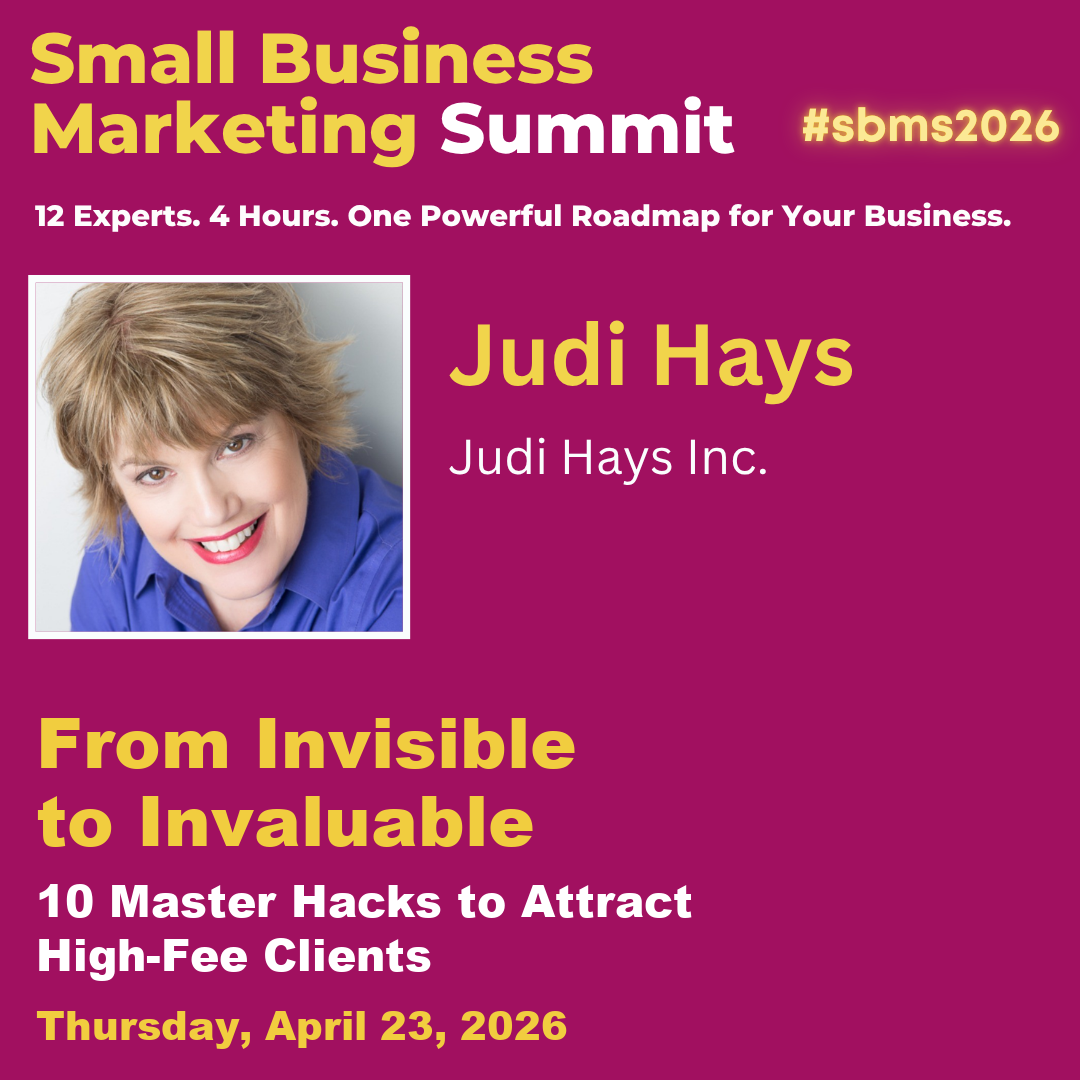
Small Business Marketing Summit with Brenda Meller
Judi Hays presents at the Small Business Marketing Summit, a virtual event hosted by Brenda Meller of Marketing with Meller. In a 10-minute talk, Judi shows experienced executives and consultants how to move from identifying with a job title to showing the outcome they deliver, so the right buyers find them and pay premium fees.
She walks through the changes that matter most on LinkedIn: an outcome-first headline, a Featured section that proves your authority, a low-friction yes-or-no question instead of “let’s grab coffee,” an About section written for the reader, and a clear position as a category of one.
Episode Key Takeaways
- Lead with the outcome: Replace the “I help…” headline and your job title with the transformation you deliver.
- Turn your experience into outcomes: Look back at what you have accomplished and describe it in terms of results, such as improved cash visibility or stronger controls.
- Make it simple for high-fee buyers: They want someone who reduces chaos and lowers risk, not vague language about your next chapter.
- Use your Featured section like headlines: Show a case study, testimonials, or something quantifiable, because buyers check you out before they contact you.
- Don’t seem too available: Ask a low-friction yes-or-no question instead of “let’s grab coffee” or offering open calendar slots.
- Write your About section for the reader: Start with the problem your buyer is facing, and use decision-maker language, named frameworks, and a clear position as a category of one.
Watch Now
Appearances By

Brenda Meller
Brenda Meller hosted the Small Business Marketing Summit. She is the host of the Enthusiastically Self-Employed Podcast and also facilitates Marketing with Meller (MwM), a membership and learning community for the self-employed. Learn more about Brenda Meller.

Judi Hays
Judi Hays is a personal brand strategist, executive positioning advisor, and LinkedIn expert. She positions experienced professionals and leaders of established, expert-led B2B consulting and professional-services firms for visibility, authority, and decision-maker conversations. Learn more about Judi Hays.
Session Transcript
This transcript was generated from the episode audio and lightly edited to remove filler words and obvious repetitions. It may contain transcription errors.
Brenda Meller:
And our next presenter is Judi Hays. Judi is a member of Marketing with Meller as well. She joined in September of 2024, and you might be thinking, wait, Brenda, why are you bringing your competition into your program? I don't look at people like Judi as competition. I look at her as a co-competitor, someone we cooperate with, because when we support and help each other, it's the rising tide lifts all ships analogy. When she proposed the topic, LinkedIn, you might think, wait, she's on your turf. No, she's not, because I'm not LinkedIn, and Judi's not just LinkedIn. It's one of the areas we specialize in, and it's almost like we're looking through a kaleidoscope. Her angle might be slightly different than mine, so I'm sure I'm going to learn things from Judi in today's presentation as well. Judi, with that said, the floor is yours.
Judi Hays:
Thank you. Welcome, everybody. It's funny, Brenda, I found that old report you used to pull, the LinkedIn Rock Stars, and that's how we got on each other's radar. Your philosophy has always impressed me, and it also aligns with Bob Berg's The Go-Giver. I don't know if anyone here is familiar with that book. I absolutely love it. I actually send it to people along with a copy of my own book, because I believe in it so much. It's the idea that we all help one another.
What I wanted to talk about today is not so much LinkedIn, but more positioning and branding. People talk about those words a lot. Branding is really how people perceive you, and if you position yourself correctly, the people you want to reach can find you. I work with experienced executives, age 50 plus, and I've walked the same path. These are people who have built their whole careers on their job title. They identify with the job title, and now there's been a shift. Either they've retired, or they've been aged out, or they're just done with the corporate world, and they're invisible. They don't actually need more visibility. What they need is more credible visibility. If you identify with that, put a "Y" in the chat. The kind of credible visibility these people need is the kind that builds trust and attracts high-fee opportunities. Let's face it, you've spent 20 or 30 years building your skills, so let's clarify your position so the right buyers find you first.
I'm also proud of myself for this: I built this presentation in Claude, in a project called Cowork, and I can't believe I did it. It's possible to learn new tricks.
I have a framework called Elevate, Expand, Engage, which happens to be the title of my book. The first part is how you present yourself, and I've come up with 10 hacks, if you will. One of the things I see, and I do work on LinkedIn a lot, is the headline.
Hack #1: The Outcome-First Headline. Whoever started this "I help..." approach, it's a cliché. Everybody helps somebody. So let's reshape it and lead with the outcome. What is the outcome? What is the transformation you deliver? We're trying to create a category of one and set you apart. Instead of saying "executive coach for tech leaders," how about "scale your leadership team without becoming the bottleneck"? Do you see the transition there? Instead of what you do, it's the outcome you bring. That's the first hack, or mindset shift.
Hack #2: Make Your Invisible Pedigree Legible. The second one is that a lot of us have credibility that just isn't brought up. We've worked for decades and done amazing things. Sometimes I go back and look at what I've done and think, oh wow, I can't believe I did that. So instead of calling yourself a fractional CFO, look back at everything you accomplished and say that you help growth-stage companies improve cash visibility, strengthen controls, and prepare for strategic transactions. Again, it's not so much identifying with a job title as identifying with the outcome you deliver. Does that make sense?
Hack #3: Sell Calm, Not Clarity. The other thing is that, especially with high-fee buyers, they don't want vagueness. They want somebody who makes it simple for them. It's like, fix this for me, please. Reduce chaos, lower the risk. You have to create that confidence. So instead of saying, "I help professionals find clarity in their next chapter," I say, "I translate executive experience into visible authority, so accomplished leaders can attract high-value opportunities in their next chapter." Notice the words: executive experience, visible authority. It's a whole different thing, and what my ideal client will see is, yes, that's what I want.
Now we look at the expansion part, which is how the buyers find you. Remember what I said about being an invisible expert.
Hack #4: The Digital Due Diligence Filter. There's a due diligence part. If you all open an incognito browser and put your name in a Google search, take a look at what shows up. Probably your LinkedIn profile will be one of the first or second results, unless you're somebody like Brenda Meller, who has a podcast and a book, so other things show up. But for the most part, before anybody does business with you or spends money with you, they're going to ask, who is this person, and are they the real deal?
One thing you can do is use the Featured section on your profile. I think of it like the latest headlines, and you can change it as often as you like. If you're speaking somewhere, or doing something, or you have a case study, you can put that there. You can also use it for things that are quantifiable, something you've accomplished that you want to put out there. Right now I've changed my Featured section to include testimonials. All of them are in my Recommendations section, but I extracted a few salient quotes that I wanted to feature. I encourage you to look at the Featured section as a tool.
Hack #5: The Advance Question. Here's the next thing. A lot of people say, "Let's grab coffee," or "Let's hop on a call." It kills your authority and makes you seem too available. If I ever click on somebody's profile and they have all these time slots available, I think, good gosh, that means your calendar is free all those times. That's a perception. Your lead-in should be a little different. Ask a low-friction yes-or-no question, like, "Are you building a board right now?" or, "What is your go-to marketing strategy for the next fiscal year? Let's chat about that." Obviously we want to engage with people, but how you frame it definitely builds your authority.
Hack #6: The Customer-Centric Summary. The next one has always been a pet peeve of mine: the About section. It's not about you. It's never about you. It's about the person reading it. So instead of "I have 20 years..." and so on, nobody cares. Start with the pain or the problem your high-fee buyers may be facing. Talk to them: "You've built something remarkable, and now you're at an inflection point." That's going to attract them more than saying you have 20 years of experience, because honestly, that doesn't matter to them.
Hack #7: Layer Systems on Your Wisdom. The next part is Engage, and how you prove your authority. You have different kinds of expertise, and there's efficiency, so come up with names for your frameworks, like a recipe. The Four-Step Exit Strategy is one example. It gives you something that is unique to you.
Hack #8: Use Decision-Maker Language. The next one is decision-maker language. Avoid the "coachy" words. Use the language of the person who signs the checks, because that's what resonates with them.
Hack #9: Create Visible Judgment. The next one is visible judgment, which is making the right decision in a messy situation. Try examples like a decision framework or a trade-off analysis. And
Hack #10: The Category-of-One Hybrid. the last one is being a category of one, a hybrid. If you look like every other consultant, you're a commodity, so you want to bridge two worlds. Instead of saying you help X, Y, and Z, use phrases like "board-ready CFO for founder-led SaaS companies."
If you're ready to clarify your position, scan the code or use the link, and let's chat. I'd love to talk with you. Thank you.
Brenda Meller:
That was a really good presentation. I've advised clients on the "I help" statement, especially when they have a job title at a company, but what you did took the "I help" to a whole other level, elevating it and using different combinations. Really brilliant. I'm going to have to re-watch everything Judi said. Judi, can you remind us, if people are interested in working with you, what services and offerings do you have that they might want to learn more about?
Judi Hays:
I have a couple. One is that I do LinkedIn profile transformations, which is a four-week engagement. My latest offering is the 90-Day Authority Intensive, where we break it into phases and work through every aspect of your positioning. It's me working with you, and you get a recording of each session. I guarantee it: at the end of the 90 days, if you are not in conversations with these high-ticket opportunities, and ready to at least send a proposal or sign a contract, I will continue working with you. That's how much I believe in the process. And of course, I have a book too, Elevate, Expand, Engage.
Brenda Meller:
I have the book. If anyone has books, feel free to drop the links to them in the chat. I'm a big believer in supporting fellow authors and fellow business owners. Judi, thank you so much. Delightful to hear from you.
FAQs
Judi Hays says to lead with the outcome instead of what you do. The “I help…” headline has become a cliché, because everybody helps somebody. Name the transformation you deliver. For example, instead of “executive coach for tech leaders,” use “scale your leadership team without becoming the bottleneck.”
The goal is to create a category of one and set yourself apart. Today, Judi helps clients rewrite their headlines in her Strategy Lab.
Write it for the person reading it, not about yourself. Judi Hays says nobody cares that you have 20 years of experience, so start with the pain or problem your high-fee buyers may be facing. For example, you might open with “You’ve built something remarkable, and now you’re at an inflection point.”
That attracts buyers more than a list of credentials, because your experience doesn’t matter to them until they see you understand their situation. Today, Judi helps clients do this in her 90-Day Authority Intensive.
Judi Hays thinks of the Featured section as your latest headlines, and you can change it as often as you like. Use it for a case study, something you are speaking at, or something quantifiable you have accomplished. She recently changed hers to include short testimonial quotes pulled from her Recommendations section.
Buyers look at your profile before they contact you, so the Featured section is a chance to prove your authority at a glance.
Judi Hays says those calls to action can kill your authority and make you seem too available. Open calendar slots create the same perception: it suggests your calendar is free all the time.
Instead, ask a low-friction yes-or-no question, such as “Are you building a board right now?” or ask about their go-to marketing strategy for the next fiscal year. You still engage with people, but the framing builds your authority.
Judi Hays works with experienced executives who have built their careers on a job title and now feel invisible, whether they retired, were aged out, or are done with the corporate world. They don’t need more visibility. They need more credible visibility.
Look back at what you have accomplished and describe it as outcomes, not a title. For example, instead of “fractional CFO,” say you help growth-stage companies improve cash visibility, strengthen controls, and prepare for strategic transactions. Today, Judi helps clients position themselves this way in her 90-Day Authority Intensive.
Start by looking at what buyers see. Judi Hays suggests opening an incognito browser and searching your own name, because your LinkedIn profile is probably one of the first results. Before anyone spends money with you, they check whether you are the real deal.
Then make the profile do the work: an outcome-first headline, a Featured section that proves your authority, and an About section that speaks to your buyer’s problem.
Use the language of the person who signs the checks. Judi Hays says to avoid “coachy” words, because high-fee buyers want someone who makes things simple, reduces chaos, and lowers risk. Decision-maker language is what resonates with them.
She also suggests naming your frameworks, such as a four-step exit strategy, so your approach feels unique to you, and sharing visible judgment through a decision framework or a trade-off analysis.
Become a category of one. Judi Hays says that if you look like every other consultant, you are a commodity. Bridge two worlds so buyers can see exactly who you serve, such as “board-ready CFO for founder-led SaaS companies.”
Instead of saying you help X, Y, and Z, be specific about your outcome and your audience. Today, Judi helps clients refine their positioning in her Strategy Lab.